Hettinger County Dog Registration Information
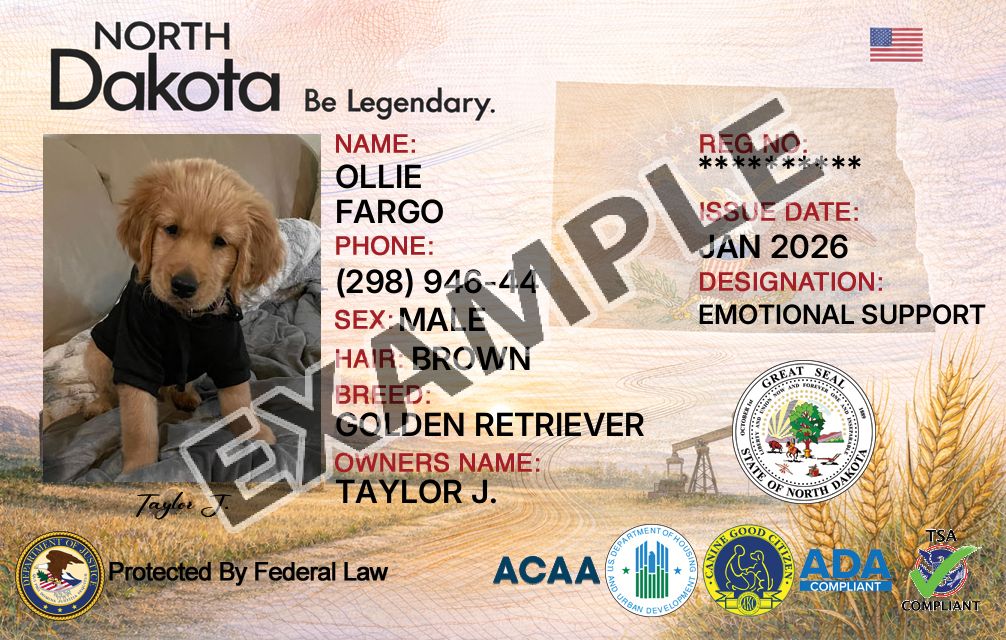
Service Dogs and Emotional Support Animals in Hettinger, North Dakota
If you’re searching where do I register my dog in Hettinger County, North Dakota for my service dog or emotional support dog, the most important thing to know is this: dog registration (licensing) is usually handled locally—often by a city office (like a city hall/auditor) if you live inside city limits, and by county-level offices or law enforcement/public health partners for certain enforcement and rabies-related requirements. This page explains where to register a dog in Hettinger County, North Dakota, what paperwork is typically required, and how licensing differs from service dog rights and emotional support animal (ESA) accommodations.
- A dog license in Hettinger County, North Dakota (when required) is a local registration/tag process tied to rabies vaccination and ownership.
- Service dog status is based on training and disability-related tasks—not on registration papers or online certificates.
- Emotional support animals are not service dogs under the ADA; ESA accommodation typically applies to housing (and sometimes other limited contexts).
Where to Register or License Your Dog in Hettinger County, North Dakota
Because dog licensing is commonly administered at the city level, start with your city hall if you live in Mott, New England, or Regent. If you live outside city limits (rural Hettinger County), licensing may be handled differently depending on local ordinances and enforcement practices—so the best starting point is often the Hettinger County Sheriff’s Office and/or the local public health unit for rabies guidance.
Hettinger County Sheriff’s Office
- Address: 336 Pacific Ave
- City/State/ZIP: Mott, ND 58646
- Phone: (701) 824-2935
- Mailing (if needed): PO Box 157, Mott, ND 58646
- Email: Not listed in official source
- Office hours: Not listed in official source
Southwestern District Health Unit (Hettinger County Local Public Health)
- Address: 309 Millionaire Ave
- City/State/ZIP: Mott, ND ZIP not listed in official source
- Phone: (701) 824-3215
- Email: Not listed for the office as a general inbox
- Office hours: Not listed in official source
Mott City Hall
- Address: 202 E 3rd St
- City/State/ZIP: Mott, ND 58646
- Phone: (701) 824-2163
- Email: citymott@ndsupernet.com
- Office hours: Not listed in official source
Hettinger County Courthouse (General County Contact)
- Address: 336 Pacific Ave
- City/State/ZIP: Mott, ND 58646
- Phone: (701) 824-2645
- Email: Not listed in official source
- Office hours: 7:30 a.m. – 4:30 p.m. (closed 12:00 p.m. – 12:45 p.m. for lunch)
Overview of Dog Licensing in Hettinger County, North Dakota
What “registering your dog” usually means
In many North Dakota communities, “registering” a dog means obtaining a local license or tag issued by a city (often through the city auditor/city hall) and sometimes supported by local law enforcement for enforcement. A license helps connect your dog to you if the dog is lost, and it also supports compliance with rabies vaccination requirements.
Who handles a dog license in Hettinger County, North Dakota?
There is no single statewide “pet registration” office for all residents. Instead, a dog license in Hettinger County, North Dakota is typically handled locally:
- Inside city limits (Mott, New England, Regent): Start with your city hall/city auditor’s office. This is the most common place for licensing and tags in small ND cities.
- Outside city limits (rural Hettinger County): You may still have rules through township/county ordinances or enforcement practices. Call the Sheriff’s Office to ask where licensing and complaint enforcement are coordinated.
- Rabies and vaccination documentation: Public health offices can help explain acceptable proof and rabies-related public health procedures.
Rabies vaccination requirements (why they matter for licensing)
Rabies prevention is handled through a mix of veterinary practice, local ordinance requirements, and public health enforcement protocols. In practical terms, many licensing processes require you to present proof of current rabies vaccination from a veterinarian. If your dog bites someone or is exposed to a potentially rabid animal, public health and law enforcement may become involved, and vaccination records can affect required quarantine or observation steps.
How Dog Licensing Works Locally in Hettinger County, North Dakota
Step-by-step: how to get an animal control dog license in Hettinger County, North Dakota (common local workflow)
- Confirm your location: Are you inside Mott, New England, or Regent city limits? If yes, start with the city office. If no, start with the Sheriff’s Office for the correct local rule and contact.
- Gather documents: Bring or email your rabies vaccination certificate (and any other vaccination records your local office requests).
- Apply and pay: Many communities issue a tag after payment of a local annual fee (amount and exemptions vary by city ordinance).
- Keep your tag and records accessible: Some ordinances require the tag to be attached to a collar; even where not required, it helps with identification.
- Update when things change: If you move, change phone numbers, or transfer ownership, update your information with the local licensing office.
What if you have a complaint, bite incident, or rabies concern?
If you’re dealing with a roaming dog complaint, a bite incident, or questions about rabies observation/quarantine procedures, call the Hettinger County Sheriff’s Office and the local public health unit. These situations are typically handled through local enforcement and public health protocols, not through “service dog registries” or online documentation.
Does a service dog or ESA change licensing requirements?
Sometimes city ordinances treat service animals differently for fees or certain restrictions, but that varies by locality. Even if a service dog is exempt from a fee in some jurisdictions, rabies vaccination and responsible control requirements still apply. The key point is that a license (or rabies compliance) and “service dog status” are different concepts.
Service Dog Laws in Hettinger County, North Dakota
Service dog legal status is not created by a license or registration
A service dog is generally understood as a dog that is individually trained to do work or perform tasks for a person with a disability. This legal status comes from what the dog is trained to do and the handler’s disability-related need—not from purchasing an ID card, vest, certificate, or adding the dog to a database.
What businesses and offices can ask
In public places, staff typically cannot demand medical records or require a “registration certificate” for a service dog. In many situations, questions are limited to confirming the dog is a service dog required because of a disability and what tasks it is trained to perform. If your dog is behaving aggressively or is not under control, it may be excluded even if it is a service dog.
How this ties back to dog licensing in Hettinger County, North Dakota
Even when a dog is a service dog, local governments may still require compliance with rabies vaccination, leash/at-large rules, and other public safety measures. If you need to know whether there is a local fee exemption, ask your city hall or the Sheriff’s Office where enforcement is handled.
Emotional Support Animal Rules in Hettinger County, North Dakota
An ESA is not the same as a service dog
An emotional support animal provides comfort by its presence, but it is not trained to perform specific disability-related tasks in the same way a service dog is. That difference matters: ESAs do not generally have the same public access rights as service dogs.
Where ESAs are most commonly recognized: housing
ESA requests most often come up with landlords, property managers, or housing providers. Documentation typically involves reliable support for a disability-related need for the animal. This is separate from local pet licensing. In other words: even if your dog is an ESA, you may still need to follow local rules for vaccination, at-large restrictions, and any animal control dog license Hettinger County, North Dakota requirements that apply where you live.
Avoid “instant ESA registration” claims
If you see services claiming they can “register” your ESA to make it official nationwide, treat that carefully. In practice, what matters most is whether your housing provider recognizes your documentation under applicable housing rules and whether you comply with local public health and safety rules (like rabies vaccination).
Frequently Asked Questions
What You May Need
- rabies vaccination proof
- identification
- proof of residency
- licensing fee
Register A Dog In Other North Dakota Counties
Select your county below to get started with your dog’s ID card. Requirements and license designs may vary by county, so choose your location to see the correct options and complete your pup’s registration.
- Adams County Dog Registration
- Barnes County Dog Registration
- Benson County Dog Registration
- Billings County Dog Registration
- Bottineau County Dog Registration
- Bowman County Dog Registration
- Burke County Dog Registration
- Burleigh County Dog Registration
- Cass County Dog Registration
- Cavalier County Dog Registration
- Dickey County Dog Registration
- Divide County Dog Registration
- Dunn County Dog Registration
- Eddy County Dog Registration
- Emmons County Dog Registration
- Foster County Dog Registration
- Golden Valley County Dog Registration
- Grand Forks County Dog Registration
- Grant County Dog Registration
- Griggs County Dog Registration
- Kidder County Dog Registration
- LaMoure County Dog Registration
- Logan County Dog Registration
- McHenry County Dog Registration
- McIntosh County Dog Registration
- McKenzie County Dog Registration
- McLean County Dog Registration
- Mercer County Dog Registration
- Morton County Dog Registration
- Mountrail County Dog Registration
- Nelson County Dog Registration
- Oliver County Dog Registration
- Pembina County Dog Registration
- Pierce County Dog Registration
- Ramsey County Dog Registration
- Ransom County Dog Registration
- Renville County Dog Registration
- Richland County Dog Registration
- Rolette County Dog Registration
- Sargent County Dog Registration
- Sheridan County Dog Registration
- Sioux County Dog Registration
- Slope County Dog Registration
- Stark County Dog Registration
- Steele County Dog Registration
- Stutsman County Dog Registration
- Towner County Dog Registration
- Traill County Dog Registration
- Walsh County Dog Registration
- Ward County Dog Registration
- Wells County Dog Registration
- Williams County Dog Registration